
I won the Customer Success award at the Salesforce UK annual meet this year. I was overwhelmed as everyone in Salesforce holds customer success as a top priority. So winning this award meant a lot to me.
Customer success is a team effort. So I owe this recognition to the fantastic and super talented team from Salesforce, Client and Partner who helped in implementing a Multi-Cloud solution to deliver a great value to our client. I am grateful to the people who nominated me and to the judges for selecting me as a winner.
I have been inundated with many questions from colleagues and friends on my consistent track of turning around projects and making customers even greater advocates for Salesforce.
So what’s my secret?
Being a certified Brain Coach helps me to understand how we can optimise individual and team performance. Here is a short summary of the brain chemicals followed by some of the top ideas on how I use them and implement them in my projects.
Understand the key brain chemicals (fuel) responsible for high-performance
Happiness Advantage: Our brain is a vast biomechanical network. Similar to a car which has different fluids (brake fluid, engine oil, etc.), the brain also has different fuels for different functions. The fuels for the brain are called neurotransmitters. Neurotransmitters release both happy chemicals and unhappy chemicals. When they release happy chemicals, we feel happy, we are more creative, collaborative, and communicative and we broaden our perception. When they release unhappy chemicals, we feel sad, stressed and our performance drops.
Happy chemicals do not last long. So we have to continuously replenish them. Unhappy toxic chemicals like “Cortisol” last much longer and continue to impair memory, attention and focus.
Brain Chemistry
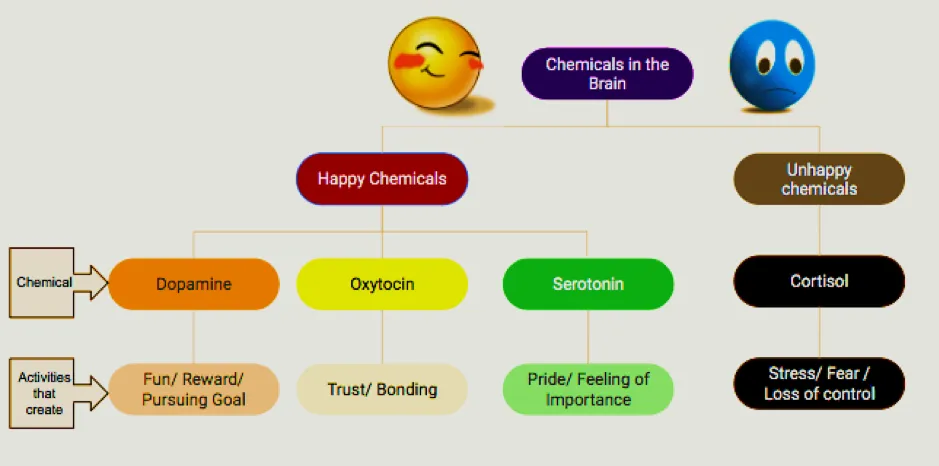
Fear Chemical — “Norepinephrine”: A little bit of stress is important for optimum performance. During that time, the brain releases the “Norepinephrine” chemical. It is a fear chemical, that is responsible for attention. When “Norepinephrine” is released, it increases arousal.
There is a correlation between performance and arousal. If there is not enough arousal, then the performance is low, and if the arousal is too high, there is too much stress and performance is negatively impacted. Hence we need the right amount of stress to achieve our peak performance. Below is the performance curve showing the correlation between performance and arousal.
Performance Curve
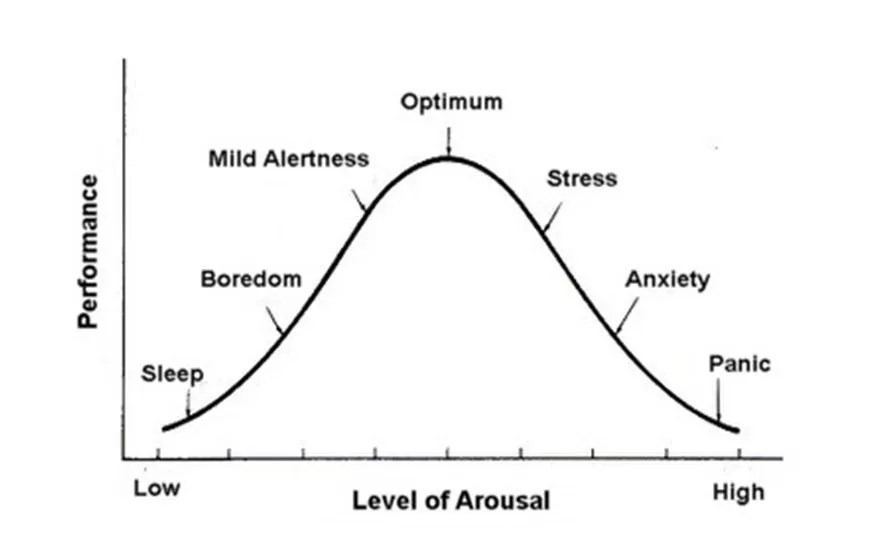
Each person’s performance curve is unique. Some people require a low level of arousal to give peak performance and others will need a high level of arousal ( for instance, making a spontaneous presentation to a large audience). So, it is important to know each team member’s performance curve.
In a nutshell, we should strive to do activities that help in releasing happy chemicals, avoid the activities that release unhappy chemicals, and sprinkle a little bit of fear chemicals to bring out the best in us for high performance.
SOLUTION:
I apply the above understanding of brain chemistry in all my projects in below steps:
1. Trust (Releases Oxytocin)
Empathy, authenticity, and transparency are the key elements to build trust. I am genuinely interested in creating value for the customer. This is my top priority and governs all of my decisions. Even if that means challenging my own colleagues when the wrong decision is made. This sort of unbiased behavior helps in establishing the spirit of the ‘ONE’ team. Over the years a simple thought like, ‘How can I help this person?’ and acting with that attitude has helped me immensely in building a high-trust relationship. This helps me in understanding things from another person’s perspective. The other person unconsciously picks up the energies emitted by a caring thought. This helps in defusing team conflicts as well. A trusting environment provides psychological safety to team members and releases the happy chemical “Oxytocin”.
2. Personal Connect (Releases Oxytocin)
Know each team member at a personal level. Try and understand their strengths and weaknesses, their likes and dislikes, and their aspirations. I have one-on-one meetings with each one of my team members and we share each other’s life story. Aside from creating a good bond with the team members, this helps me in defining the ‘Why’ for the individual in the project and setting the stretched goals. This also helps in creating a personal bond and releases ‘Oxytocin’.
3. Provide Purpose and Meaning (Releases Serotonin)
Nietzsche said, “He who has a why to live for can bear almost any how”. I create an exciting story for the project that appeals to each and every person’s aspirations. I see how they can personally benefit from the project which would provide them with meaning and would drive the engagement of the team. For example, I showed a few bright young people how mastering the Salesforce platform can significantly boost their career and salary. This motivated them with a personal ‘Why’ and we got an extraordinary performance from the inexperienced team. The sense of pride and feeling of doing important work releases “Serotonin”.
4. Team Buy-In and Stretched goals (Releases Dopamine, Norepinephrine)
It is important to create a shared plan and a stretched goal. When we involve team members in the planning then they are more committed to the plan. Each individual has a unique performance curve. Knowing team members enables me to set effective stretched goals for each person based on their ability. We also have to shield the team from the “fear of failure” due to stretched goals. This is required to create the fear chemical, “Norepinephrine”, responsible for attention and alertness in the right quantity, and avoids the release of the stress chemical — “Cortisol”. This is very important and builds a high trust relationship with Client management and helps in creating a no-blame culture where individuals can work together without fear. Progress towards a worthy goal creates “Dopamine”.
5. Positive environment (Releases Dopamine, Avoid cortisol)
This is a critical factor for the team to flourish and be successful. I spend lots of time and effort in creating and preserving a positive environment. We have a No-Blame culture which includes providing immediate positive feedback, and praising good work no matter how small it is by following the mantra, ‘if you see anything good then say it all the time’. Being grateful, appreciating others, and expressing gratitude do magic in creating a positive environment. The positive feedback, fun activities and appreciation culture release an ample dose of “Dopamine”.
Doing the above does not guarantee that the project will be without challenges. It helps in creating a strong spirit of ‘ONE’ team and increases the probability of success. The feeling of togetherness improves collaboration and helps in faster resolution of the problem.
So, to create a high-performance team, we need to create an environment of high Trust (Oxytocin), progress towards the goal, immediate reward and fun activities (Dopamine), taking pride and feeling important (Serotonin) combined with stretched goals (Norepinephrine) and avoiding blame culture and stress (Cortisol).